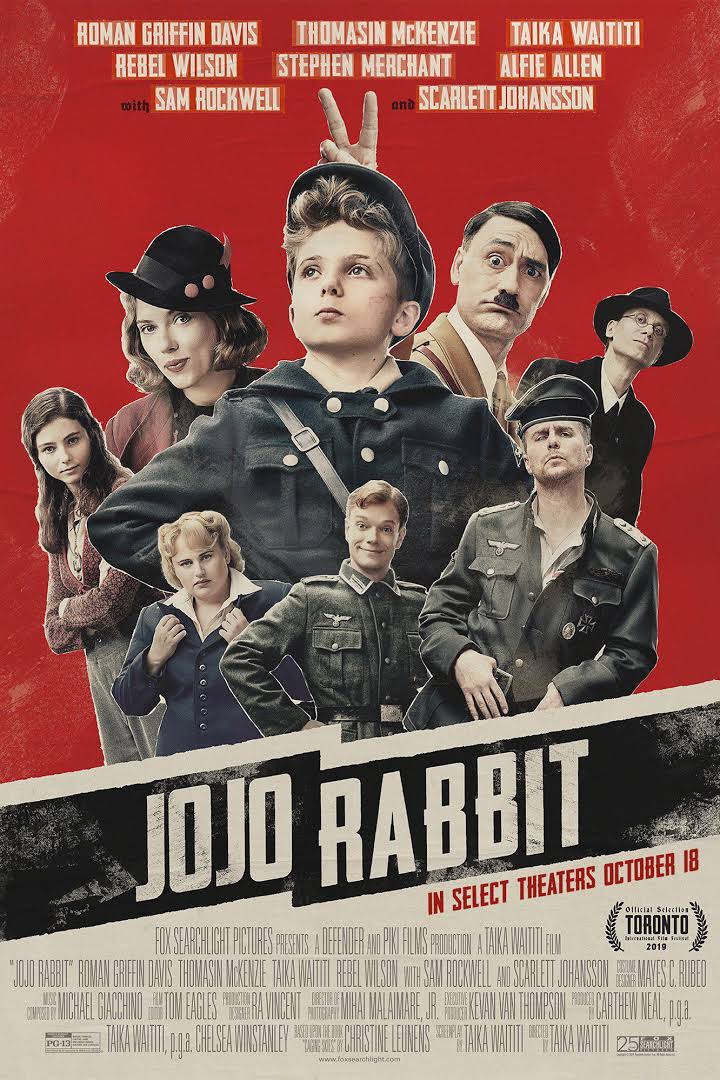
After, in my opinion, one of the best years in film for a while in 2019, it was time to start off 2020 with a film in Jojo Rabbit that has already seen a release in the United States, as well as limited previews here in the UK. With there already being Oscar buzz around the film, specifically in the Best Adapted Screenplay category, I was really excited to check it out, especially being a fan of Taika Waititi’s previous work and being intrigued by the plot.
Jojo Rabbit is a film written, directed by and starring Waititi as a young boy’s imaginary friend, Adolf Hitler. The young boy, Jojo (Roman Griffin Davis) is a 10 year old Nazi fanatic, who wants to join the Hitler youth, but is caught in a dilemma when he finds his mother (Scarlet Johannsen) is hiding a young Jewish girl (Thomasin McKenzie) in their attic. It is very loosely based on the book Caging Skies by Christine Leuneuns, but Waititi introduces a lot of differences from the source material. Even from the plot description, it is clear that this is another film where Waititi, as he has in previous films such as Hunt for the Wilderpeople and Thor Ragnarok, is attempting to mix lighter moments with a darker overall plot. The biggest risk here is attempting to do it with a highly sensitive topic, whilst highly sensitive iconography, such as the swastika is on show. In Jojo Rabbit, Waititi shows his mastery over tone and his ability to intertwine the light hearted with the heavier moments and in a way, make the lighter moments contrast to make the heavier moments hit harder. The film is very reminiscent of Wes Anderson, especially in the earlier scenes, with the shot composition and the use of vibrant colour, this works really well on two levels, firstly it helps to put the viewer into the mindset of the main character Jojo, who has been indoctrinated into the Nazi ideology and sees this really depressing moment in time in quite a whimsical way, through a child’s eyes and it also helps to keep the viewer engaged, adding a lot of life and character to the world around Jojo.
Although all of the cast act exceptionally well in the film, including the main star Roman Griffin Davis, the three standouts for me personally were Stephen Merchant, Thomasin McKenzie and Sam Rockwell. Stephen Merchant, in his brief appearance as a Gestapo officer, provides a surprisingly menacing performance, as well as displaying his usual comedic qualities to show that aforementioned contrast between dark and light that Waititi portrays so well. Thomasin McKenzie as Elsa, the Jewish girl hiding in Jojo’s attic, plays a part that could so easily have been one note, but instead adds a real sense of personality, humour and depth to the character that makes you sympathize with her without that sympathy relegating her to merely a victim, as she does show courage and strength in the face of adversity. In a similar way to his role in Three Billboards, Sam Rockwell takes a character who at first seems like he will be easy to despise in a Nazi officer who runs a Hitler Youth camp, but adds nuance to him. Rockwell has really become an actor where whenever I see his name on a cast list, I’m excited to see what he manages to do within the film, he’s always great comedically, but his acting ability within the more serious and key emotional moments seems to be getting better and better with each film he appears in.
The only problem within the film for me comes narratively. As this is a non-spoiler review, I won’t be able to delve into it too deeply, but the narrative issue comes from Taika’s imaginary Hitler. It is a really well acted part and provides a lot of the film’s comedic moments, but it doesn’t fully work for me in the sense that it doesn’t feel like it adds too much to the story. It feels like there could have been a little more progression with the idea of it, but ultimately the idea isn’t as involved in the film for a long while and when it returns, it feels like a bit of an after thought. It would’ve been more interesting to see the idea either fully realised or cut out altogether, although then it may not have felt as much of a Waititi type film. Apart from this minor potential narrative flaw for me, everything else, the acting, direction, cinematography, writing, soundtrack is all absolutely top level and helps to contribute to Jojo Rabbit being a really enjoyable and at times, very emotional, hard hitting film.
One of the best ways to fight back against hatred is to make fun of it. Once you turn something into a joke, you take away all of it’s power. Waititi crafts a story which finds the right balance, it never treats the subject too lightly, but it also heavily mocks the Nazi ideology, especially the beliefs they spread about the Jewish people and helps to reduce Hitler into a pathetic character, rather than the imposing man he is sometimes portrayed as. It elevates the idea of a satire into the next level and I came out of the film excited to see what the actors within it and Waititi move onto next. It’ll have a lot of competition for awards, as I said, I consider 2019 to have been a really strong year, but I expect at least a Best Adapted Screenplay nomination for Jojo Rabbit – it’d be well deserved.
Overall rating – 🌟🌟🌟🌟 /5
 Benson's Film Reviews