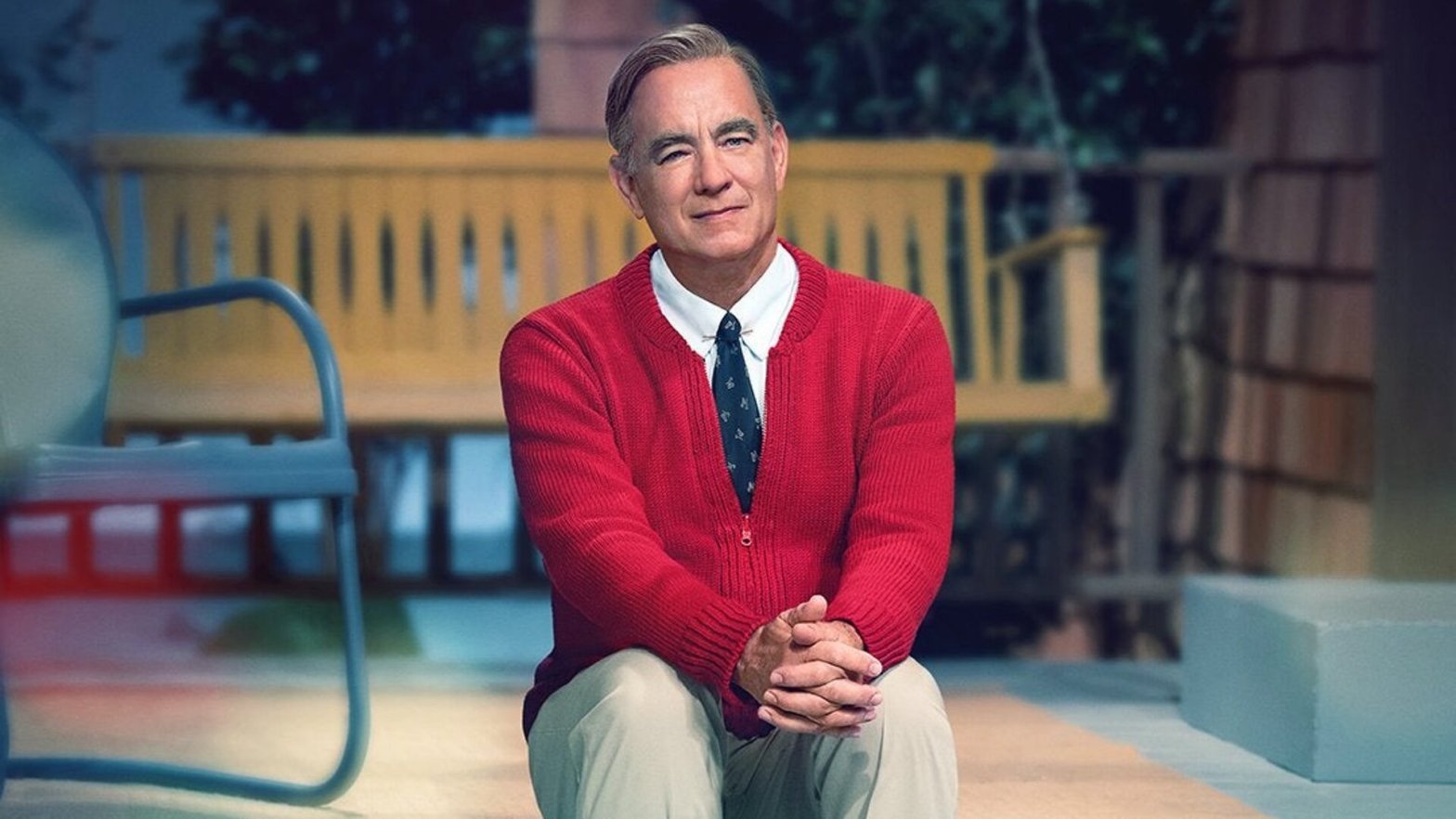
Fred Rogers was a children’s television host and creator of the long running American show Mister Rogers’ Neighborhood. While he’s not as prominent a figure in British culture, the set of his show, as well as the famous red sweater is still instantly recognisable. Mister Rogers was known for dealing with more serious topics than kids shows were normally known for doing, treating them with the sensitivity with which they deserved to be treated with, whilst also treating the kids with enough respect to be able to open discussion on these topics with them. A lot of his creative efforts were aimed towards positivity towards one another and he’s an insanely popular figure, with his words still resonating with a lot of people today, so who better to play him than Tom Hanks?
While Tom Hanks was nominated for an Oscar for his role as Fred Rogers, it is notable that his nomination was in the Best Supporting Actor, rather than the Best Actor category. That is because the film revolves around a journalist named Lloyd Vogel, who is given the assignment of writing a piece on Mister Rogers for Esquire Magazine. Although the piece is designed to focus on Mister Rogers as a hero, Vogel is initially sceptical and when the two meet, Vogel’s cynicism clashes with Mister Rogers sense of patience and optimism. The story is inspired by the real life article written on Mister Rogers in Esquire Magazine by journalist Tom Junod and to frame the narrative like this is really interesting, as it allows us to look at Mister Rogers from an outsider’s perspective and helps to see the effect he reportedly had on many people he came into contact with. Vogel is a character who is almost child-like in some aspects, someone who is at a point in his life where he needs the lessons Mister Rogers teaches and it’s incredibly satisfying to follow his character arc as the film progresses.
The theme in the film of cynicism vs. being more open and understanding was a really important one for me and something that feels really relevant at the moment. If we look at how certain issues are approached nowadays, especially with how toxic social media can get and how strong negative backlash seems to be at times, a move towards more compassion would be a welcome one. Like the journalist’s attitude at the start of the film, there are many who look to criticise just because it garners more attention, more clicks, more views and this creates an environment where people are constantly in fear of that often empty criticism, leading to them being unable to be their true selves. I can’t speak too much on Mister Rogers, as aforementioned, he isn’t as prominent in British culture, but a lot of his work seemed to be about building people up rather than knocking them down and this leads to a really heart warming message and journey within the film. Themes of fatherhood and the harm of holding onto grudges are also prevalent and they also pay off really effectively and emotionally in the film as well.
Whether or not the film leans too heavily into over-sentimentality will all depend on your tastes, but for me, it got the balance just right. With Mister Rogers not being the central figure of the film, the viewer is given just enough of him so that his personality doesn’t become too overbearing, which could have been a possibility if the film had been made with him as the main focus. Instead, he is more of an influence on events, entering here and there and the emotional moments are given the time and respect that they deserve, without being overdone and pushed too heavily onto the viewer. The other thing that makes the film work in this regard is that all of the main characters are fully developed, although Vogel is cynical, he’s not merely a caricature, the reasons for his cynicism are fleshed out and we’re able to understand and empathise with them. Similarly with Mister Rogers, he isn’t made out to be entirely perfect, but rather a man who’s just trying his best to slow things down, appreciate them moment by moment and keep open to other people and their feelings.
The film is beautifully directed by Marielle Heller, who injects a lot of life and energy into this story. She switches the film between telling the story and mixing in elements of the Mister Rogers Neighborhood show to frame the telling of it. This is a really clever way of incorporating the show into the narrative of the film and it allows scenes that could have been merely transitional or expositional to become a lot more visually interesting, with the aspect ratio changing each time too to mimic the TV show. This framing device also allows the character of Mister Rogers to speak directly to the viewer. Tom Hanks does fit this role well personality wise, but looking at real life footage of Fred Rogers, he has both the vocal inflections and movements perfected to a very impressive level, showing that Hanks must definitely have done a strong amount of research for the role. We also have Matthew Rhys as Lloyd Vogel, who performs very well, with a lot of the film focusing on his emotional journey. Susan Kelechi Watson and Chris Cooper star as Andrea Vogel and Jerry Vogel respectively, Lloyd’s wife and Lloyd’s father who he has a tenuous relationship with, both actors get a lot to do with multi-layered roles and they do great with it too.
A Beautiful Day In The Neighborhood is a simple story elevated by the creative approach taken to it, the direction, the acting and the writing for each character. It is quite nice to watch a feel-good film, but even nicer to watch one where there’s a huge amount of talent, effort and love involved in the telling of it. It helps to keep it fresh in the mind that there are many different ways to tell a story, to move a scene along, to advance the plot and that if you look to keep the film engaging and stimulating, it really can lift a story from being a good one, to a great one.
Overall rating – 🌟🌟🌟🌟/5
 Benson's Film Reviews