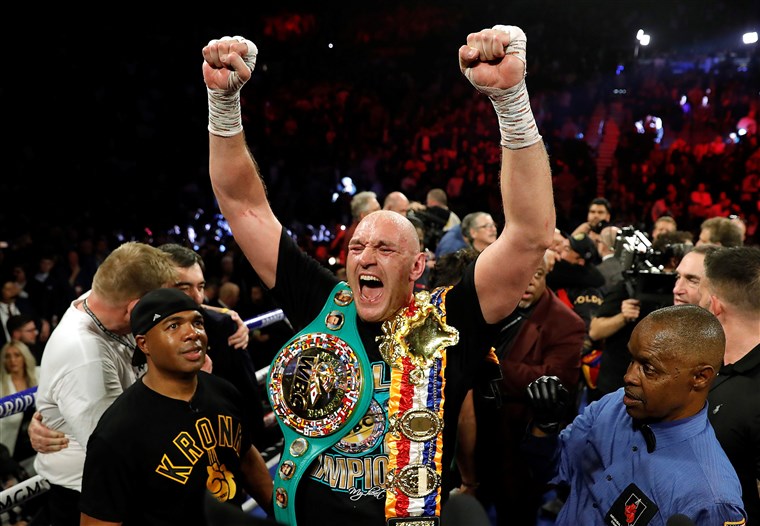
Failure has become a dirty word. It’s something that a lot of people don’t want to talk about, something that gets swept under the rug and yet it’s the one thing that every single one of us has in common. Everyone, especially including myself, has failed at one point or another and been forced to react to it. Losing isn’t pleasant, it takes you to some of your darkest places and a lot of the time it seems like you’re going to be stuck in those places forever. The idea of failure and what we can learn from it, how we react to it, has been playing on my mind for a while, but Tyson Fury’s victory in the rematch vs. Deontay Wilder brought it back to the forefront of my mind again.
Tyson Fury previously beat Wladimir Klitschko to win the WBA, IBF, WBO, IBO, Ring magazine and lineal heavyweight championship in 2015, to the shock of a lot of boxing experts, he was accomplished at British level, but due to his weight and perceived poor defensive tactics, it was seen as unlikely that he could win against Klitschko, an established and highly rated champion at world level. For Tyson though, this was the start of a fall into addiction and mental health struggles, two issues that had been there under the surface, but had been fully uncovered by reaching the highest of highs. In the build up to a planned rematch with Klitschko, Fury seemed far removed from his usual self, seeming disinterested, tired and in one concerning pre-fight face to face, alluding to suicidal thoughts. In a later interview with the Rolling Stone magazine, Fury would go on to say ‘I hope I die every day.’ After a postponement and a charge from the UK anti-doping agency for cocaine use, as well as concerns over Fury’s weight gain, he vacated the world titles won against Klitschko, before having his boxing license suspended by the British Boxing Board of Control. Out of boxing, struggling with depression and gaining weight to the point of being 28 and a half stone, Fury became a figure of fun in some of the nastier British tabloids.
A lot of people doubted Fury’s ability to come back, especially the man who he’d eventually go on to take the heavyweight title off, Deontay Wilder. This was something that helped to bring Tyson back from the brink. It’s hard to summarise the incredible size of his comeback here, how many mountains had to be climbed for Fury to lose all that weight, get his license back and step back into the ring again. I’d encourage anyone who hasn’t already to look deeper into his story – it’s fascinating. He worked incredibly hard on all aspects of himself over a gruelling amount of time, but he did it. After two and a half years out of the ring, Fury came back, with a warm up fight against Sefer Seferi on an undercard fight at the Manchester Arena. Only one fight after that, Fury was fighting Wilder for the heavyweight title in LA, a fight many believed Fury to have won, but it was declared a draw. In the 12th round of that fight, Fury was sent to the canvas with two clean punches from Wilder, but got back to his feet to deny the American the win. Then, in the rematch on February the 22nd 2020, Fury went out, dominated Wilder with an aggressive, positive performance and stopped him in the seventh round to reclaim the WBC heavyweight title. Fury had done it, he’d come back after being written off by many and after struggling with the toughest of battles. His story is a reminder that nothing is ever done, every situation can be turned around and that even in the darkest of circumstances, there can always be hope. His victory wasn’t only in the ring, he also seems more comfortable with himself and more able to deal with his mental demons. Depression never goes away, but he now seems better equipped to deal with those darker moments when they come.
It seems like a lot of the time in today’s culture, failing at something publicly means that you’re done, finished or ‘cancelled’. But this simply isn’t a healthy way to live your life. Like I said earlier, every single one of us has, or will fail at some point. Failure is just part of the learning process, it’s how you get better, every huge victory is the result of a lot of losses, often times losses that have come in private, losses that have led to frustration, anger and self doubt. With a lot of negative emotions, the best thing to do isn’t to ignore them, but rather to learn how to process them in a healthy way. You have to deal with them, but not dwell on them and let them consume you to the point where they’re having a heavy, detrimental effect.
For me, I hit a big personal loss towards the end of last year and I didn’t have a clue what to do. I tried to ignore it for a while, pretend that everything was fine and just shove past it. But you can’t do that, everything you try to bottle up just comes along later on, in a much more forced and aggressive manner. The result of bottling it up hit me hard, sending me into some really low moods and pushing a lot of self-doubt into my mind. I found that it was a lot easier to try and look at it in a rational way – what had happened? What could I have done better? Even still, was there anything I could have done better? Sometimes a perceived failure isn’t even down to your actions, it’s just all down to circumstances or outside influences. The best way is to look at it is from situation to situation and deal with it from there, recognise what happened, take what you can from it and try to push on. You shouldn’t try to force yourself to forget it, failures are part of us all and part of the journey. I found everything much easier once I’d opened up, spoken about it and began accepting that what happened had happened.
I think as people we all need to become more comfortable with the idea of failure and losing. This doesn’t mean not caring, not in the slightest, instead it means looking at what you can and can’t change. Frustration and upset is natural, but it can then be harmful if these feelings stick around for way too long. It can be hard sometimes, especially if you’re a pretty harsh self-critic. The media and social media can both contribute to this a lot. Very few people are going to share their moments of defeat publicly and with good reason, but it’s important to remember that we all have them. Social media can be a strange place when you’re at a low point, because a lot of it can lead to comparing your life to others, when it’s not an accurate representation, so it can sometimes do some good to pull away for it slightly and put things into perspective. The media in Britain forms bizarre narratives out of winners and losers, where it’s framed as if those who lose just disappear and become irrelevant, but life doesn’t work in such a simple way, it’s more complex. There’s no such thing as rises and falls in the way that they’re usually depicted, life isn’t a film. Life is a constant rise and fall and once you become accustomed to that, losing hits you way less hard and allows you to focus on the next chance to succeed.
Ultimately, no feeling is final and no situation in life is permanent. Sometimes the brain has a funny way of making you feel like it is, but it’s not the case. Where would most of the people you know in life be if they’d given up after a perceived failure? Where would Tyson Fury be? As a kid, I used to write a lot of stories and scripts, probably at least two or three short stories a week, just for fun, because I was really into my writing. As I got older, I found I was more inclined towards starting up a story or a script and then quitting as I got halfway, or even a quarter of the way through. When I was younger, I had no worries about whether what I was doing was good, or shit, I was just going for it, but as you get older, you do become more self aware and too much of it can hold you back. You can start thinking all the time instead of actually taking any action. The only way you ever get experience or progress is by practising your craft and fear of failure can hinder this massively. So now, I’m trying to mix both approaches, having that more mature analytical approach, accepting that’s part of growing up but also trying to keep that fearlessness I had as a kid. I know I’ll probably fail a load more times in the future, but I’m okay with that now. Because I know through that failure, I’ll end up somewhere great. We all will.
 Benson's Film Reviews