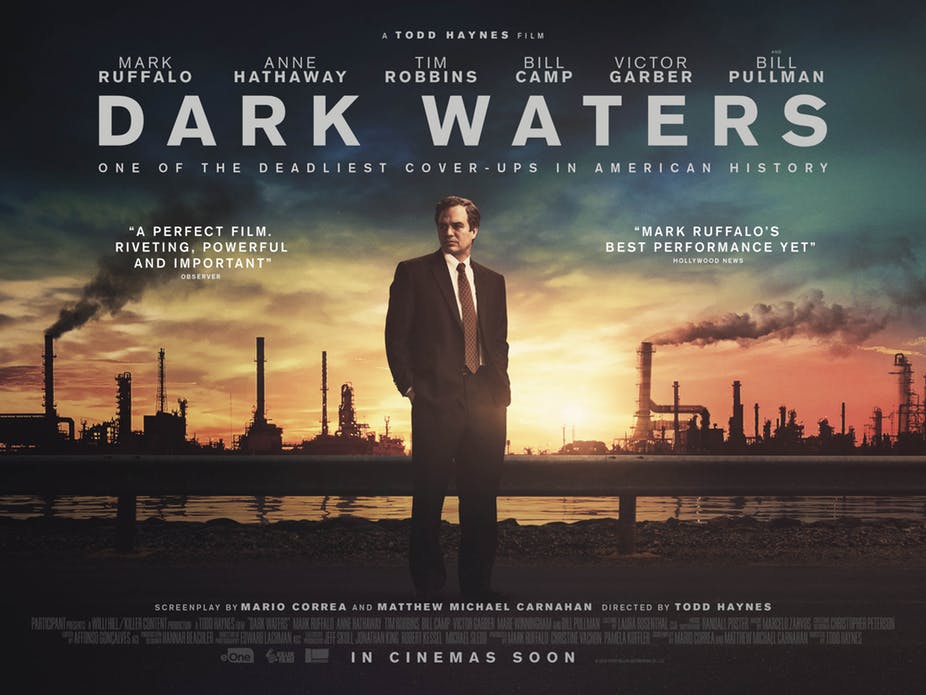
Stories based upon real-life events can be both incredibly gripping and important at the same time. On seeing the trailer for Dark Waters, directed by Todd Haynes, I was immediately pulled in through the promise and potential of the plot. These types of films, when done right, can help to bring serious issues to the forefront of the public consciousness and there is always a tightrope to walk in making them dramatically interesting whilst at the same time not letting this overwhelm the serious aspects of the issues being portrayed. In terms of dramatically interesting, this doesn’t mean turning the situation into a Hollywood spectacle, but rather looking into where the dynamics are in the narrative and using them to make the story the most powerful it can be and remaining true to the facts at the same time.
Dark Waters is a film about Robert Bilott, played here with a great amount of intensity by Mark Ruffalo, a corporate lawyer for chemical companies who becomes conflicted after being approached by a client to look into American company DuPont in relation to the amount of pollution they are knowingly adding to the water supply. After beginning to research more into the case, Bilott becomes determined to take on DuPont in a seemingly unwinnable case and the film follows his effort across the years to expose their unethical practises. Even from the brief synopsis, the real life intrigue as well as the intrigue ready to be delved into cinematically is evident, we have the potential redemption arc from his role as a defendant for the companies who then turns to work against them, as well as the always appealing narrative of the underdog taking on the corporate giant in a courtroom battle.
You can tell from the performance from Ruffalo that this is a story that means a lot to him and he gives an urgent, at times desperate performance as a man under a lot of stress and pressure. His character arc isn’t as well crafted as it could be, a little more build up and justification for his decision to switch sides on the chemical companies issue would have helped to identify with his character a little more. Anne Hathaway plays Bilott’s wife Sarah, performing well as always and although efforts are made to show how Bilott’s battle against DuPont is taking it’s toll on his family as well as him, the results of this are fairly mixed, as the family drama pales in comparison to the scale of the legal battle and the discovery of the heights that the pollution levels DuPont has inflicted on the local communities has reached. A lot of the performances apart from Ruffalo’s are toned down, obviously purposefully to maintain that realistic tone, but they can sometimes feel more muted than they need to be.
As the story is told quite competently, it often feels like as though the creativity in telling it has been somewhat stifled. The direction and cinematography is never particularly flashy or showy. It could be argued that this isn’t needed for a film like this, but due to it’s style, the themes don’t feel as if they’re delved into any deeper than at the surface level and this leads to the emotional hits later on in the film not landing as strongly as they might have done. Whilst the narrative is about the real life case, it is also about the story of Robert Bilott, why he felt such a connection and a need to take on the pressure of the case. We get this in small doses, but ultimately a lot more was needed in the build up to get across the scale of the incident and the effect that it was having upon everyone involved. A lot of the film can feel expository and by the end, it feels as though it is skipping through a lot of major points in the story, feeling as though you are reading a Wikipedia entry on the case, rather than watching a film about it.
As I previously said, it can be a challenge to tell a real life story, especially one that’s quite political, while keeping in mind that film is a visual medium and should be treated as such. There’s so much more that can be done to elevate a story from being interesting to also being visually engaging. Having said that, the film is certainly not shot poorly, it’s shot well enough, the acting is solid and it managed to keep me engaged throughout, purely on the basis of the intrigue of the story alone. The film has been described as a political thriller, although the thriller elements are quite minimal in truth. It is more of a drama, fairly slow moving, taking you through the timeline of this investigation. The real heart of the film is the engagement with the idea of corporate companies and how they wear people down, the attrition like approach they take to cases and the amount of money they can pour into them that makes the battle feel near impossible. We see real life people from the events appear in the film which I thought was a really nice touch, it just would’ve been nice to see more of that type of thing.
Despite a lot of the flaws with Dark Waters, this is still an incredibly vital story that needs to be watched and shared. It is a solid film, there was just the potential for so much more if the script had been stronger and the direction had been a little more creative. After all, the better the film is, the more it’s going to be discussed and the more the message is going to get out there. The facts, of course, should remain largely the same in a whistle-blower type film like this, but that shouldn’t necessarily hold the film back in terms of creativity. That is and always should be open to be experimented with when it comes to film.
Overall rating – 🌟🌟🌟/5
 Benson's Film Reviews