By Tom Benson
So I read an article this morning in The New Statesman, written by Sarah Manavis, entitled ‘It’s okay to complain about how much we’ve lost because of Covid-19’. I found this article incredibly interesting, as it summarised a lot of my recent thoughts around why this particular stretch of lockdown has been and continues to be so difficult for so many people. Essentially, the article goes in depth around how our collective attitude towards one another and our individual struggles that relate to lockdown have changed and intensified since last March. I’d highly recommend giving it a read as it does reflect upon quite a lot of the online attitude that has been prevalent recently.
In particular the quote – ‘Policing the yearning to return to our previous lives achieves nothing; it only fractures ourselves as a collective, and heaps yet more stress and despair on to those already suffering.’ spoke to me a lot, as this ‘policing’ is something I have seen a lot of online recently. It’s really not our job, nor should we want it to be, to police each other or shame one another for wanting to return to social and meaningful events. I really feel that type of attitude has been detrimental for some people in getting through this and although I recognise that it may be a different type of coping mechanism for some, it’s also incredibly unhelpful for those that this type of diatribe is being aimed towards. People react differently to ‘crisis situations’ based on varying factors, but we all need to make sure we’re being respectful to each other’s worries and concerns when it comes to what we’re dealing with right now.
I also saw an article shared by Sky Sports shared on their Facebook page over the weekend which was entitled ‘COVID-19: Empty football stadiums ‘contributing to depression epidemic’. The headline might not be the best at putting across what the article actually contains, which nowadays obviously means a lot of people have ended up missing the point of the story altogether. While there are comments in reaction to the Facebook post that managed to understand it, there are also some that are completely reflective of the type of attitude discussed in The New Statesman article. I’ll leave some pictures of examples of these types of comments below.
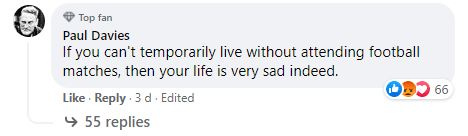
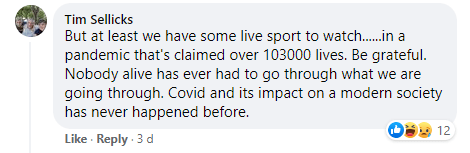

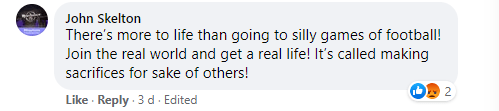
The content of the article heavily contrasts with the attitude displayed in these comments and helps to show the actual impact of the situation that is being discussed. Obviously online there are a lot of people who comment upon topics that they would not discuss that way in real life. Often personalities and views are heavily over exaggerated, but sadly these type of comments are widespread around a lot of different types of events at the moment and they are potentially really damaging. It isn’t just football. It’s everything. From gigs, to nights out, to gym classes where people socialise with one another, any kind of event or setting where you meet with others, essentially. We’ve become increasingly isolated from one another for an extended period of time and to pretend that doesn’t have a negative effect is beyond delusional and can be quite dangerous.
The article contains an interview with Neil Waine, who works with Andy’s Man Club, a network of free drop-ins aimed at helping men open up about their mental health problems through peer support. Andy’s Man Club has seen a huge increase in interest since the start of the pandemic and subsequent halt of football fans being allowed into stadiums. Neil stated within the interview;
“A lot of the guys who come to our sessions are football fans and they’re really missing that. I know guys who sit near me at the football and that’s their only social contact in the whole week.”
“March will be a year since football grounds closed and that’s a scary thought, that some people have been isolated for that long.”
As usual, stereotyping is an issue here, as many see those who attend football as just young lads going out to get pissed up and while that is certainly partly true and also does not mean that demographic cannot be affected by issues of loneliness, depression etc. anyway, there are also a lot of older people who attend football matches and see it as their bit of social contact each time a match comes around. People from across all types of demographics attend football matches and a lot of them do so for more than just to watch the football. Some people I know who go to the match are pretty fed up with football on the whole, but they go purely for the social side that going to the game provides. The loss of that social side cannot be ignored and empathy must be shown towards those who are struggling with that aspect not being in their lives for such a long stretch of time.
Bringing in a view on this from a health care perspective, I want to briefly include content from a BBC article published yesterday that is called ‘Coronavirus doctor’s diary: We’re getting self-harming 10-year-olds in A&E’. Here, the brutal effects that can stem from feelings of extreme anxiety and feelings of isolation, especially in those who are younger, are put on full display. I’m not here to make an argument for or against lockdown, because this post isn’t about that and it wouldn’t make a difference to what I’m trying to focus upon here, but rather to point out that there are effects of lockdown that need to be addressed and focused upon urgently. We can talk about hypotheticals all day long, but this is the stark reality of what is happening now that we need to deal with and recognise. On a wider level, it is clear that more attention and investment is needed in mental health services or we are going to find ourselves up against a rapidly mounting challenge with very little respite or let up. This needs a plan and has to be highlighted as much as possible now, with action points put in place to help as many people as possible. It simply can’t be swept under the carpet for a moment longer.
Lockdown “massively exacerbates any pre-existing mental health issues – fears, anxieties, feelings of disconnection and isolation,” says A&E consultant Dave Greenhorn, as quoted in this article. So a huge issue is having to deal with those who already have pre-existing mental health issues that are being exacerbated by the effects of lockdown, but on top of that there is a growing number of people experiencing mental health issues or struggles for the first time due to the long term social isolation that is being experienced, along with many other issues. The article states that ‘Children in mental health crisis used to be brought to A&E about twice a week. Since the summer it’s been more like once or twice a day.’ Similar figures are reflected across various age groups in regards to severe mental illness being on the rise.
Before the first lockdown, I used to go to the gym in the Manchester Aquatics Centre in town, as it was about a five minute walk from my University buildings, meaning that I could go in before and after lectures/seminars. It was perfect, it obviously had a few large swimming pools, an absolute load of treadmills meaning there was always one available and even a few weights, even though I mostly used it for cardio workouts at the time. Once it became evident that I was never going to return to Uni again before my Masters course finished I had to cancel my membership there, instead using the weights equipment that I have at home and running/walking regularly to replace the workouts I was doing at the Aquatics Centre. However, when my friends who use gyms and/or make their living through gyms being open rallied around and were passionate about them being kept open due to the mental and physical benefits vs. the statistically low infection rates, I supported them all the way. I signed their petitions, I engaged with them and I listened to what they had to say. Just because personally I had stopped having a gym membership for the time being, it didn’t mean that I dismissed the concerns or worries of other people who were affected by the situation.
Up until early November last year when the tier system came in, my release had become going to the cinema every week/every other week with my friend Kev. Each week it seemed like a different part of the experience was taken away, it started off with us going to see a film and then going for a pint and a chat afterwards, until bit by bit it got cut down as restrictions were placed upon more than one household going into a pub. Then eventually, the cinema was cut too and hasn’t returned since that point to this day. Now obviously before the cinema being closed I also had football matches taken away, gigs taken away, I had been stopped from seeing close friends and family for a very long time, my Uni lectures and dissertation tutoring sessions (which while still really useful to me) had switched to online, I became a single 25 year old who couldn’t get out on dates which has been really weird. The list goes on. And yet it was the cinemas shutting down for an indefinite amount of time in early November that hit me the hardest as that brief bit of time each week or every two weeks helped me to socialise just a little and get out of the house for a bit. Without that experience, even though it sounds like such a minor thing, I started to feel really boxed in and the idea that there was no end to this and it was a certainty that this situation would remain the same for a fair while longer was terrifying to me.
That’s my personal experience with how the loss of socialisation bit by bit has affected me, but this will be the same for everyone. Nobody is living life as they were before. The issue is that people are already having to deal with difficult situations, furlough, job losses, business closures, health related issues, but then are left without the usual social events which help them to momentarily take their minds off these types of situations. This can lead to everything feeling very overwhelming. Just because something isn’t as big of an issue as something else doesn’t mean that it isn’t an issue. Unfortunately, society is so wide and so varied that to focus on only one, or even just a handful of issues at a time, would mean that so many people are left behind or ignored. As we all become more emotionally aware, it is obvious that this does not need to happen, nor should it be happening. It is tough, that is undeniable, but that does not mean that the issue should not be addressed, or that attempts should not be made to rectify it as much as is possible. There is a responsibility and a duty to ensure that everyone affected in whatever way by these increasingly limiting and frustrating events are cared for and heard, not matter what element of it they are being affected by.
So, how can we help with this current problem? The answer is empathy, patience and understanding. If people are upset or worried about something, telling them that they’re daft or wrong to feel that way about it usually doesn’t lead to anything positive. Especially if someone is opening up to you about it out of confidence, it usually means that they are coming to you so that they can vent and speak about their situation without fear of judgement. There is a difficulty in this as well that I also want to acknowledge, in that this far into the cycle of lockdowns, people are really lacking in energy, which can make it a lot more difficult to support others who are also struggling mentally and emotionally. In the first lockdown there were the rainbows, the Thursday claps, the feeling of ‘we’re all in this together’. Nobody can be arsed anymore. Everybody is tired. We just want our lives back. And you know what? That’s okay. It’d be weirder if everyone didn’t feel that way. That’s probably why people who are upset about missing out on opportunities, events and key moments are getting so frustrated with being told they have to ‘make sacrifices’. At this point, everyone has made sacrifices and they don’t really need reminding of it or being admonished for lamenting those lost moments. Let’s think about how to get away from ‘policing the yearning to return to our previous lives’.
Instead, let’s support each other and recognise that lockdown is presenting different challenges for each and every one of us. Let’s not play that down, but recognise those challenges and allow people to let off steam at times if they feel like it’ll help them through. One of the most difficult things about all of this is that it can be really hard to offer any advice or find any positives in the situation. A lot of the situation, especially now, is just about getting through it in the best way that you possibly can. For a lot of people, their coping strategies have been nullified and the events and people that usually help to carry them through are out of bounds. I find one thing that has been useful is discussing any positive aspects of news with other people. Despite the daunting situation, there are moments of light out there that are important not to lose sight of. The recent ‘mutant virus’ headlines amongst others have been really frustrating, but maybe the lack of social responsibility from many media sources could be a whole other post on it’s own.
If you’re reading this and you’re badly struggling or you know someone who is, I have left some links to online mental health resources at the bottom of this post. I’ve also linked the New Statesman, Sky Sports and BBC articles down below if you want to check them out. These types of articles being shared really help to enable people to talk about their feelings and the impact that the situation is having so that people are not left to feel lost or neglected. That kind of alienation and the feeling of being unable to discuss how you’re feeling for fear of being shamed can make a tough situation even tougher. If each one of us shows unity with one another, as well as an effort to understand and listen, it will make everything easier for everyone at a time when everything else around us seems to be so brutally harsh and negative. Let’s keep up a positive, empathetic energy for those we know and even those we do not and together, we can get through anything that gets thrown at us.
It’s okay to complain about how much we’ve lost because of Covid-19 (newstatesman.com)
COVID-19: Empty football stadiums ‘contributing to depression epidemic’ | Football News | Sky Sports
Coronavirus doctor’s diary: We’re getting self-harming 10-year-olds in A&E – BBC News
Samaritans | Every life lost to suicide is a tragedy | Here to listen
Mind | Mind, the mental health charity – help for mental health problems
How to access mental health services – NHS (www.nhs.uk)
YoungMinds – children and young people’s mental health charity
Mental health help and support services | Time To Change (time-to-change.org.uk)
 Benson's Film Reviews