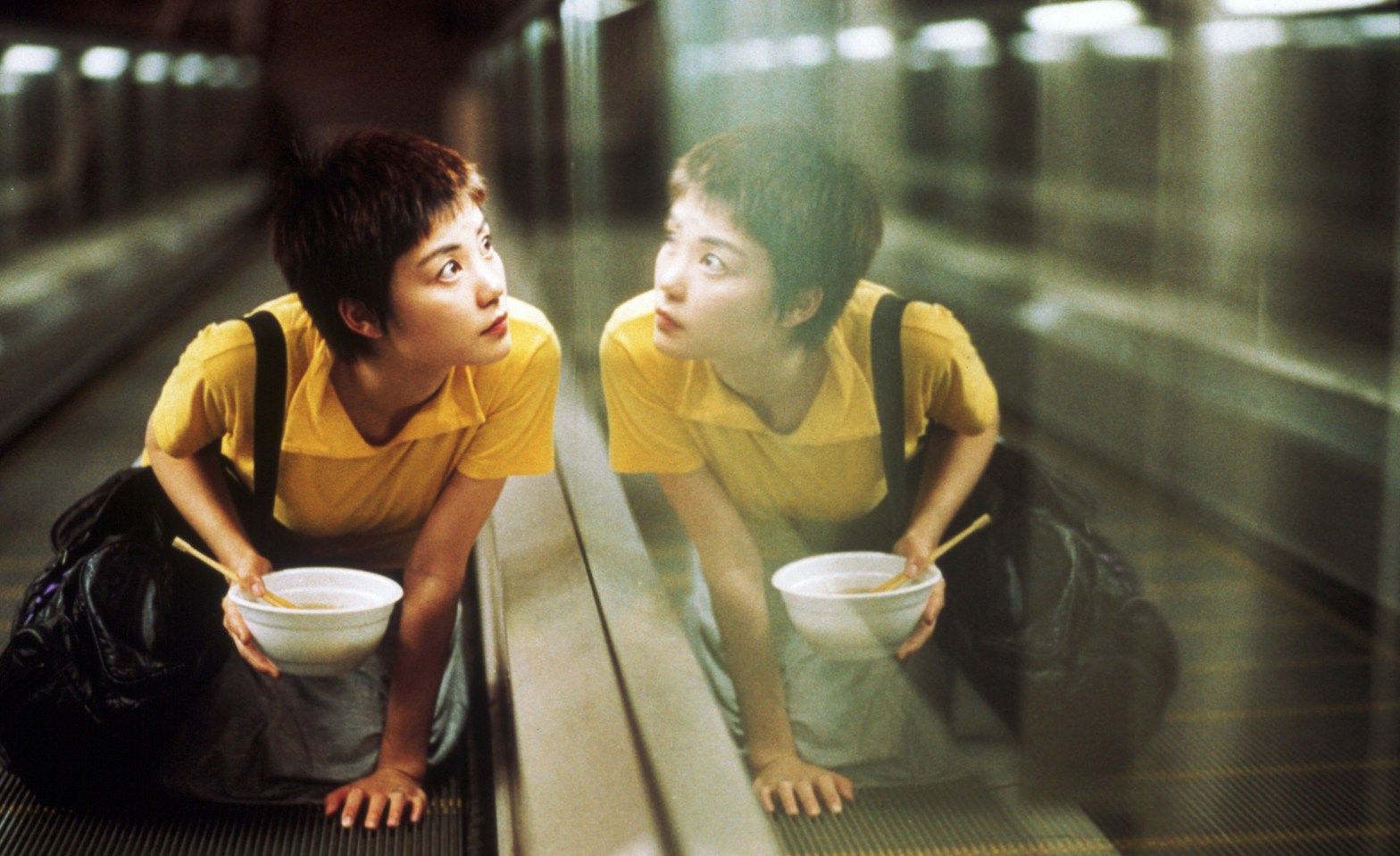
Having a bit more spare time on my hands than usual and with no new films of any note to take a look at, I decided to make a list of films I’ve been meaning to see, but haven’t got around to watching and choose a few from it to finally watch. This film, 1994’s Chungking Express, directed by Hong Kong film director Wong Kar-wai is acclaimed, particularly by Quentin Tarantino, who said when he first saw it that he ‘started crying’ as he was ‘just so happy to love a movie this much’. Watching the film, you can see why it appeals to Tarantino so much, it’s got a nice smooth pace to it, as well as a catchy soundtrack and sharp dialogue. It’s always strange going into a film that does have that level of acclaim attached to it, as you’re not always sure what to expect. As such, I went into this film with an open mind, not looking at any further reviews, plot synopsis or trailers for it, instead letting the film make it’s impression on me as it went along.
The film contains two separate stories, although both are set within the same area and are thematically linked. The first story follows a policeman still hurting from a breakup who encounters a woman while out drowning his sorrows, unaware that she is a drug dealer. The second story, which seemed to take up a larger portion of the film, is about another policeman, also going through a breakup, who begins to fall for a snack bar worker. Both stories deal with the heartache, loneliness and confusion that can begin to take hold once a relationship falls apart. Although the film features a lot of humorous moments and exchanges, there’s also a lot of introspection here as we dig into the character’s thoughts and feelings. In this sense, the film hits quite emotionally and feels quite naturalistic too, with a more urban and grounded focus a lot of the time on how these sorts of situations affect people. It focuses on the mundane parts of a breakup, the loss of routine and the quieter moments that can almost feel like a loss of identity.
One way in which Wong Kar-wai does this is through his portrayal of time. In the film he uses a technique where he speeds up everything around a character, but slows down the character themselves to impress upon the viewer how that character is experiencing time at that moment. This helps to tie into the feeling of the loss of routine after a breakup and whilst it is visually impressive, every time he implements it, there is always a narrative reason for doing it. Time is a central theme in Chungking Express, with characters either having too much or not enough of it. But much like a breakup, whilst they stand still, the world around them moves on. Dutch angles are also used frequently within the film, again fitting in narratively to put the viewer inside the head space of a character. Looking back at the film, the narrative itself is not overly complex and in the hands of another director, it may not have worked, but every technique Wong Kar-wai uses here helps to make the film a brilliant form of visual storytelling, which ultimately is what separates a good film and a great one.
Music is also used as a recurring motif, with the most notable use being of The Mama’s and Papa’s ‘California Dreamin” in the second story, along with a Cantonese cover of The Cranberries ‘Dreams’ by Faye Wong, one of the actresses in the film. Both of these help to characterise Wong’s character, also named Faye and her desire to escape and travel beyond her current situation. A lot of films do use recognisable songs in their soundtrack, some to good effect and some to bad effect. Some films, for example, Suicide Squad, use popular songs on their soundtrack to create a sense of recognition, but they fail to link to any key themes or ideas that the film presents. The best use of them is when they relate to the themes of a film and the characters within them, as they do here. As well as relating to Faye herself, the songs also help to relate to some aspects of her relationship with the policeman. It expresses the idea that their relationship may well be doomed due to the daydreaming nature of Wong’s character. Again, linking to Tarantino’s own enjoyment of Chungking Express, this is something that he has taken on in his own films, even using a cover of ‘California Dreamin” in his film Once Upon A Time In Hollywood.
I’m a huge fan of films that manage to replicate a feeling or emotion. For example, I love horror films that can build up a sense of tension and anxiety. With films about romance, I love the type that replicates how real life relationships feel and how troubles within them affect both of the people involved. Chungking Express does this to an almost scary level and even though there are a few aspects that are slightly quirky, at it’s core there’s a lot here that’s relatable for myself, as I’m sure there will be for many others too. The way in which it displays certain aspects of breakups is incredibly intimate, there was one scene in particular in the first story where the policeman does something, which I won’t spoil, out of complete desperation and loneliness. This scene manages to be both funny and desperately sad at the same time, again, one of the things that impresses me is the ability to mix tones, because that’s how real life plays out. If it had been an overly sombre or overly comical look at these themes, it wouldn’t have hit anywhere near the levels that it does, but the film has a particular style that makes it incredibly enticing.
Chungking Express is quite rightly considered a classic. It’s a beautifully bittersweet film with characters that draw you in. When the film ended, I found myself wanting to know more about what happened to the characters next, whilst at the same time not doing, due to the realistic nature of how relationships are treated in the film. Out of the two stories, the second resonated with me more, mainly due to the connection between the policeman and the snack bar worker feeling more built up and therefore creating a stronger emotional feeling at the key points in their story. The acting performances from the four main actors, Takeshi Kaneshiro, Brigitte Lin, Tony Leung and Faye Wong really help to work towards crafting these characters and as much as Wong Kar-Wai’s writing and directing is a huge part of making this film work, as well as the cinematography, the actor’s work in making these characters endearing at the heart of it help to elevate the film to another level. This is one I’d highly recommend.
Overall rating – 🌟🌟🌟🌟🌟/5
 Benson's Film Reviews